

Pickleball instruction: How to play mixed doubles with your significant other (and not argue with them)
They don’t call it “Mixed Troubles” for nothing. While a regular pickleball partnership has its own challenges, playing pickleball with your significant other is a different sort of challenge altogether.
Below we’ll explore tools to help lifetime partners who wish to also be pickleball partners. There is a world in which this can happen – without the angst.

Have a communication plan first
A common problem that arises in any pickleball partnership is how players communicate with one another. This problem is only exacerbated when your pickleball partner is also your lifetime partner. Small problems we may have off court get magnified when we step on the court.
Effective communication is a whole topic – and it well exceeds the scope of this article. What we can address here is the effectiveness of having a plan for on-court communication BEFORE you step onto the court. Things like:
– You can/cannot make play or strategic suggestions to me when we play.
– I prefer you speak to me like this: ______________________________.
– I prefer you NOT speak to me like this: __________________________.
– If I say “potato chips” (or other trigger word), you will stop coming at me about the pickleball game.
While agreeing to these parameters off-court is not a guarantee that on-court communication will go swimmingly, it does make it easier to build toward a mutually agreeable communication plan.
It is more powerful to look at your partner and say “we agreed on _________” than to ask them to agree to do it in the moment.
Have a strategic plan
This next tool – the strategic plan – is relevant to competitive lifetime partner play. If not playing competitively, then put in some work to understand your partner’s general approach to the game: Soft game, likes to attack, poaches, does not poach, etc.
Then adapt your approach to what you expect your partner will do. Here’s an example: I am an aggressive player. If there is a choice between playing a grinding soft game or attacking, I am more likely than the average player to attack. If you are playing with me, you know to look for poaches and off-bounce speedups and can be prepared for that.
It’s the same with your partner. They have tendencies. If you are not sure what they are, then a bit of study might be in order. You can also discuss strategy off court. If you are playing competitively with your partner, then a more detailed strategic plan is in order:
– Who is the setup player?
– Who is the “hammer?”
– Do you want to hit your third shots toward the middle or to the outside?
– Who takes middle third shots?
The greater your strategic clarity, the less likely you will have discord when things get tight out there. Because things WILL get tight out there in close matches. Plus, strategic clarity allows you to play better in any event.
You WILL Miss
News Flash: You will miss shots, even “easy” ones, the next time you play pickleball.
News Flash Update: Your partner will miss shots, even “easy” ones, the next time you play pickleball with them.
As both of you will miss shots, there is no reason for you get uptight when your partner misses. There is also no reason for your partner to get uptight when you miss. The solution here is to use the “Oops Bucket” not just for you, but for your partner too.
If you do not know what the “Oops Bucket” is, click here.
Read next: The Kitchen’s top pickleball paddles on the market right now
Play Selfishly
I assume that you want to give yourself the best chance you can to win. For you – forget about your partner here for a moment. This is all about you and only you.
If you’re playing singles pickleball, then your results are in your hands. Play well and you have the best chance to win. Play not as well as you can and your chances go down.
Pickleball doubles is more complex. Your play is relevant but it does not – 100% – determine your chances for success. For that, you need your partner’s play to be as good as possible too.
What can you do to get the most out of your partner? Do you think that berating your partner, eye rolling, shoulder slumping, “arghhh” exclaiming is the best approach? Probably not.
Want your partner to play their best? Let them know that their mistakes will not upset you or bother you in the slightest. To the contrary, their mistakes are no different than your mistakes. You will both make bad shots as well as amazing shots. Good decisions and “what was I thinking?”
Whatever happens, you are in this together. It would be amazing to communicate the above to your partner no matter what. But we can also justify it through a purely selfish – I want the best chance to win for me – perspective. Whatever your motivation, let your partner know that mistakes are fine with you.
The Hackenberg Rule
A last piece of advice to best navigate partner/partner play: The Hackenberg Rule.
Jim and Yvonne Hackenberg are Hall of Fame pickleball players who have been at the game for a minute now. They are two of the best Super Senior pickleball players in the country, having won too many medals to count. Their success includes playing mixed doubles … together.
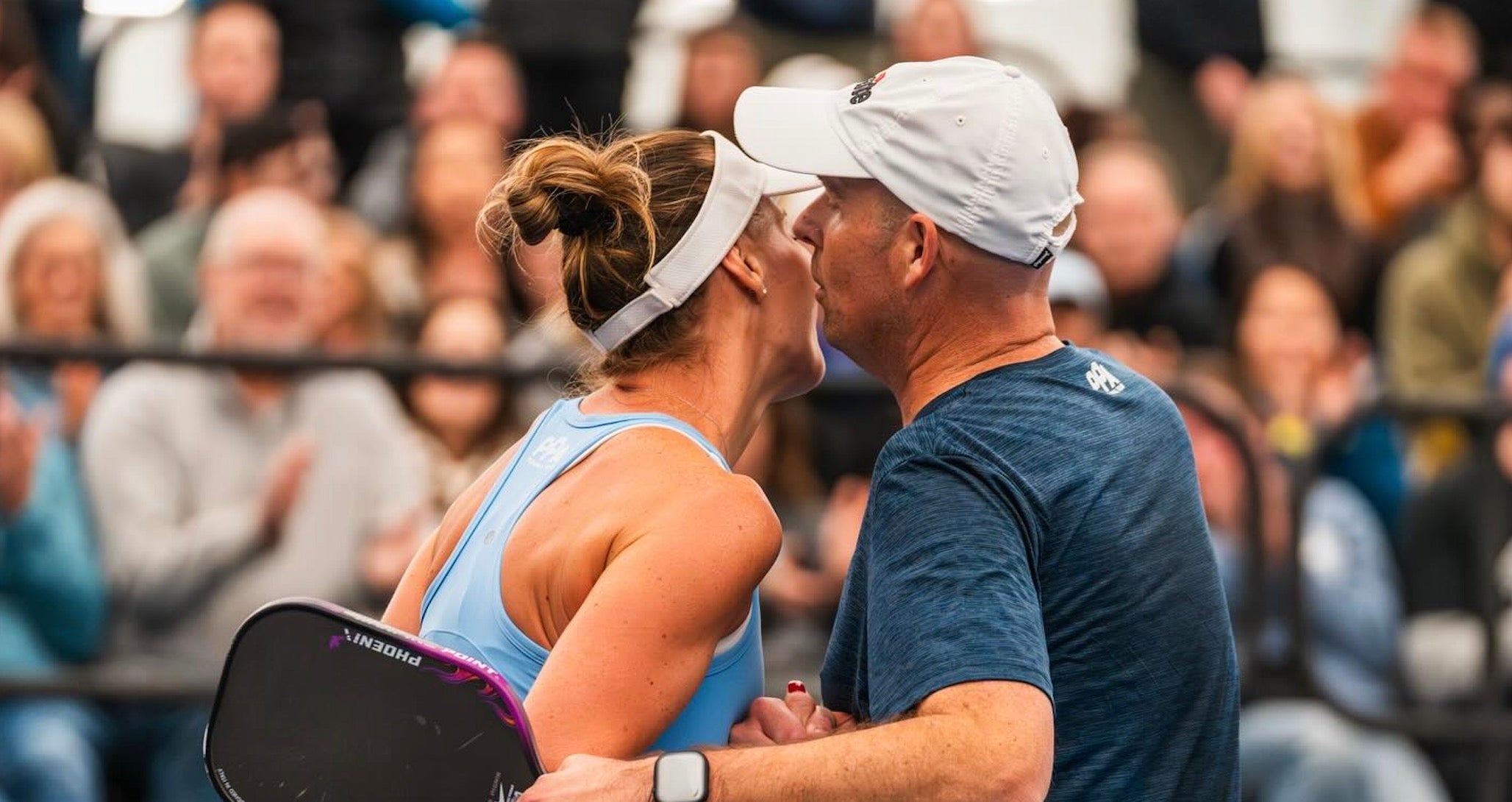
I have been fortunate to get to know Jim and Yvonne through my work. So, during a U.S. Open a few years back I made it a point to go watch them play mixed doubles. I noticed that between each rally, they would touch each other. Not paddle tap. Skin on skin physical contact. When things went well for them the rule was simple to follow and they easily exchanged an arm touch.
But things are not always easy on a pickleball court (if they were, the game would be no fun). When things got tense, it was up to the “enforcer” of their rule – Yvonne – to hold up the action until Jim walked over to make contact. The physical contact worked.
Let’s say Jim thought perhaps Yvonne should have done something differently with a shot and was mulling it over in his mind in a non-positive manner. Yvonne would stand on the court, calmly waiting for Jim to touch her arm. And when he did, it was a reset reducing (if not removing) and tension that was there.
Perhaps a reminder that Yvonne is his partner – and his partner – and that they are in this together. Perhaps a reminder that their relationship is worth way more than that rally or even that medal. It was clear that they had agreed to do this BEFORE stepping out onto the court together. And it was clear that they had put in the work so that when they were in the pressure cooker of a tournament match at the U.S. Open they knew what to do.
Click here to see Jim and Yvonne in action – and how they used their namesake “rule.”
Playing pickleball with your lifetime partner can be challenging, but also tremendously rewarding. My advice is to give it a try. Use the tools in this article to get the most out of it.
If you’re looking for more insights into high-level pickleball, the Better Pickleball Academy has you covered. You’ll also gain access to their easy to use “BP Play Guides” including middle dinking patterns and more. Use code “KITCHEN26” at checkout for a special offer just for Kitchen community members (3 months for the price of 2).
Tony Roig is a nationally-recognized coach, Sr. Pro Player, developer of “Respect the X” on the In2Pickle YouTube channel, and the voice behind the Pickleball Therapy podcast. Visit BetterPickleball.com for information on coaching from Tony and the BP team through their Camps, Academy, and No. 1 online training program: The Pickleball System.