

Keeping your pickleball results in perspective will keep the game fun
I’ve been thinking lately about the correlation between our love of pickleball and the despair it can sometimes bring.
On the one hand, we are smitten by the sport:
- We cannot get enough of it: We often play every day.
- We watch 1,000,001 videos to learn more about the game.
- We are constantly in search of the perfect paddle.
Pickleball is a highlight of our lives that brings us joy.
At the same time, however:
- We are unhappy when we “underperform.”
- We sometimes (or often) feel embarrassed, bad, or unworthy on the court.
- The pressure may rise to a level that interferes with our willingness to even engage in the sport.
Whether it’s you personally or someone you know, we each know a player who has said they thought they should just give up on pickleball. A sport that once excited them and brought such joy has somehow turned into a negative – to the point that leaving it was deemed the best option. How could this be?
I am working through an idea that these two apparently opposite things that we get from pickleball – joy/excitement and utter despair – are actually the same. Two sides of the same coin, if you prefer.
Let’s explore that a bit more, and then I will give you a big-picture idea of how to perhaps reframe the negative side of the coin in a not-so-bad light.
Why do you care?
Step back from the court and look at pickleball with a critical eye: We are out there running around a smallish court, chasing and hitting a plastic whiffle ball. That’s the whole activity.
I do not seek to diminish the activity here. Look at any sport through the same lens, and you end up in a similar place. This framing, however, can help us understand where the negative gets its power – so that we can do something about it.
SEPARATING PICKLEBALL FROM THE REAL WORLD
Each of us faces real-world decisions and actions that will have a real impact on our lives: Obtaining food, getting medical care, helping a family member in need. How we perform (or do not) in these areas can have actual real-life consequences for us and our loved ones.
On the other hand, unless you are a professional pickleball player, the outcome of a pickleball game has no real-life effects. Winning 11-0 is the same as losing 0-11. At least from a real-world perspective. Yet these two results feel vastly different to us.
Why is that? The reason is that we care. The score derives its relevance 100% from us. The score can only obtain significance if we imbue it with significance. By comparison, we lack that same power over the relevance of real-world matters.
Take consuming food, for instance. Stop consuming food, and you will not be here long – no matter what you believe about it.
PLAY WITH THE PADDLE BEN JOHNS USES
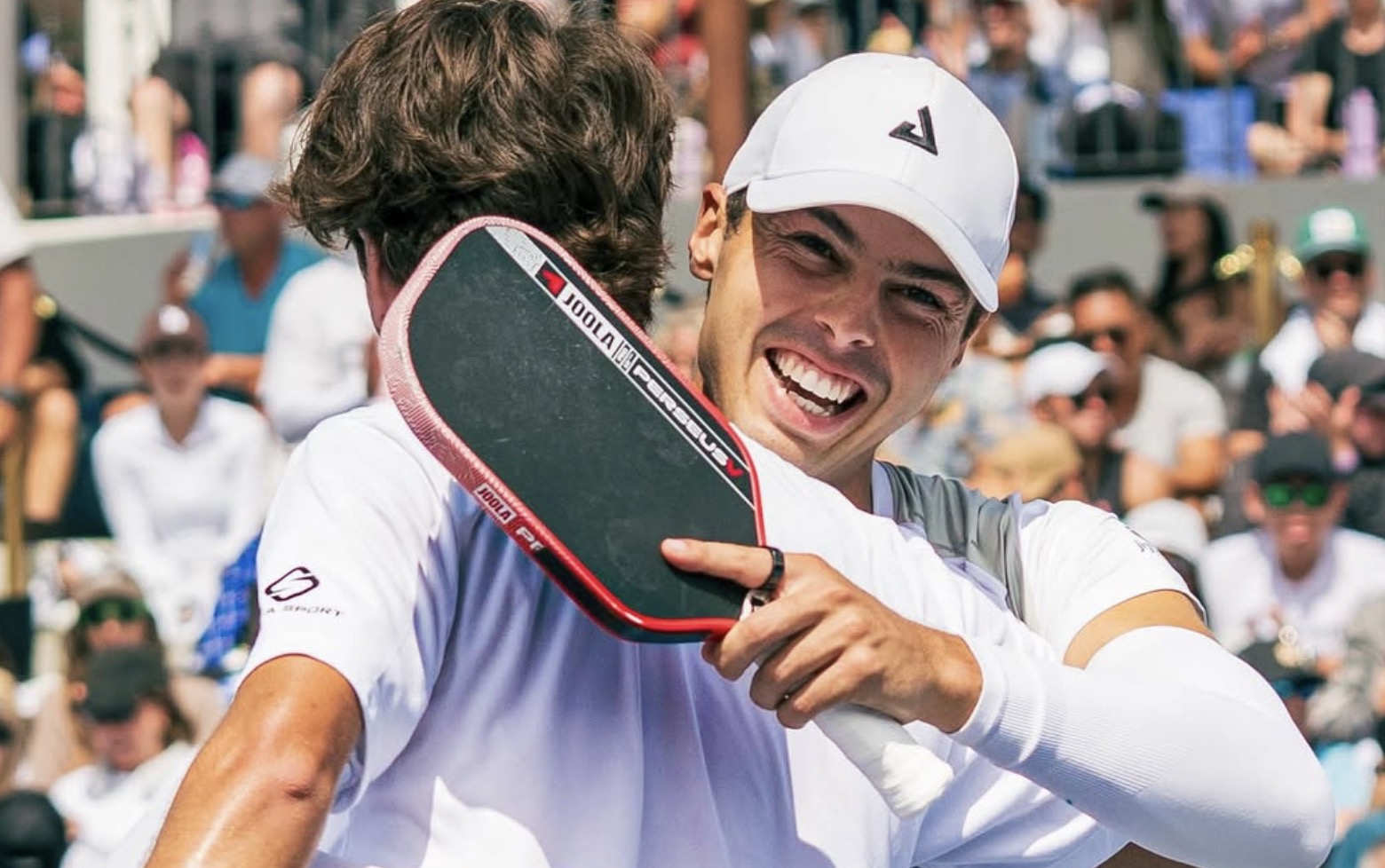
The JOOLA Pro V is one of the highest-performing paddles on the market right now.
Your ‘I care’ beam
To close the loop: The only reason a pickleball score matters to us is that we make it matter. There is no independent relevance or “power” in a pickleball score – no matter which side of the score you’re on. This means that you are in complete control over this aspect of your relationship with pickleball.
Let’s use that. I find it helpful to convert an abstract concept into a tangible one. Helps our mind get around the concept. I am reaching for one here, and the best I have right now is a beam of light, so we will go with that for now.
When we care about pickleball – including our results when we play – it is because we are shining our “I Care” beam of light on the sport. The problem is not in the beam itself – the problem is just in its width and where we choose to shine it. If we can focus the beam better, we can shine it more on what matters to us, ignoring (or at least not as brightly shining it on) what does not.
FOCUSING THE ‘I CARE’ BEAM
First, the big picture:
We want to continue caring about the positives that got you hooked on pickleball to begin with. Such as:
- Friends. What better social outlet is there?
- Health. You are likely physically healthier now than before you began playing.
- Growth/Learning. There is always more to learn in this sport.
- Challenge. Go all in on being pushed by pickleball.
We want to stop caring so much about the things that are NOT why we love the sport, such as:
- Missing a serve.
- Popping the ball up.
- Hitting a “dumb” shot.
- Losing a game.
Read next: Best beginner pickleball paddles — the ultimate buying guide
I did not include any additional descriptors to the negatives because they are not important enough to warrant further elaboration. I mean, you can make them matter – if you want. But you can also make them not matter – if you want. Up to you.
Returning to the beam idea, it is all in how wide or focused you choose to set your “I Care” beam. You can leave it wide open so that every detail of every little thing you do on the pickleball court means the world to you – both good and bad. Or you can focus your beam only on those things that you know, because you are smart, actually matter to you (see above list of reasons why you got hooked on the sport).
This approach allows you to avoid focusing your beam on the score – win or lose. Or on the silly shot you hit when your team was up 10-8-2 that “cost you” the game.
Side note here: Do not confuse the above with the idea that you cannot learn and grow from mistakes you make. That is clearly in the “focus on this” column.
What is not in the “focus on this” column is “Oh my, I cannot believe I did that. I am a bad player (or I suck at pickleball or similar).”
The difference is in the focus of the beam.
Read next: The Kitchen’s top 13 pickleball paddles on the market right now + in-depth reviews for each one
Avoiding danger
An unfocused “I Care” beam is dangerous to your relationship with the sport. Not diminishing the very real feelings a player experiences at the time, but think about this coolly for a moment: A player who loves pickleball is having difficulty with their serve. That player feels strongly enough about their struggle with this one shot that they consider, even for a moment, leaving the sport.
Again, no criticism of the feeling in the moment – but you can see how “out there” this sounds right? That is the danger of the unfocused “I Care” beam. The player’s beam is shining on a part of the game that is not central to why they play pickleball.
I am going to belabor the point one more second. If this hypothetical player ONLY liked pickleball because they got to hit a serve shot – and their serve has now gone away – then giving up the sport may make sense. Their very reason for playing would be gone.
But that is not the reason the player plays (loves?) pickleball. Focusing the “I Care” beam on the real reason(s) the player engages with pickleball (fun, friends, exercise, etc.) allows the player to avoid potential damage to their relationship with the sport from items that are not, at their core, relevant.
We each have more control over how focused our “I Care” beam is – and what we shine it on. The better you use it, the healthier your pickleball relationship will be.
If you’re looking for more insights into high-level pickleball, the Better Pickleball Academy has you covered. You’ll also gain access to their easy to use “BP Play Guides” including middle dinking patterns and more. Use code “KITCHEN26” at checkout for a special offer just for Kitchen community members (3 months for the price of 2).
Tony Roig is a nationally-recognized coach, Sr. Pro Player, developer of “Respect the X” on the In2Pickle YouTube channel, and the voice behind the Pickleball Therapy podcast. Visit BetterPickleball.com for information on coaching from Tony and the BP team through their Camps, Academy, and No. 1 online training program: The Pickleball System.