

Expert review: JOOLA’s first true hybrid — the Kosmos Pro V — checks all the boxes
This page contains affiliate links. The Kitchen may earn a commission from purchases at no extra cost to you.
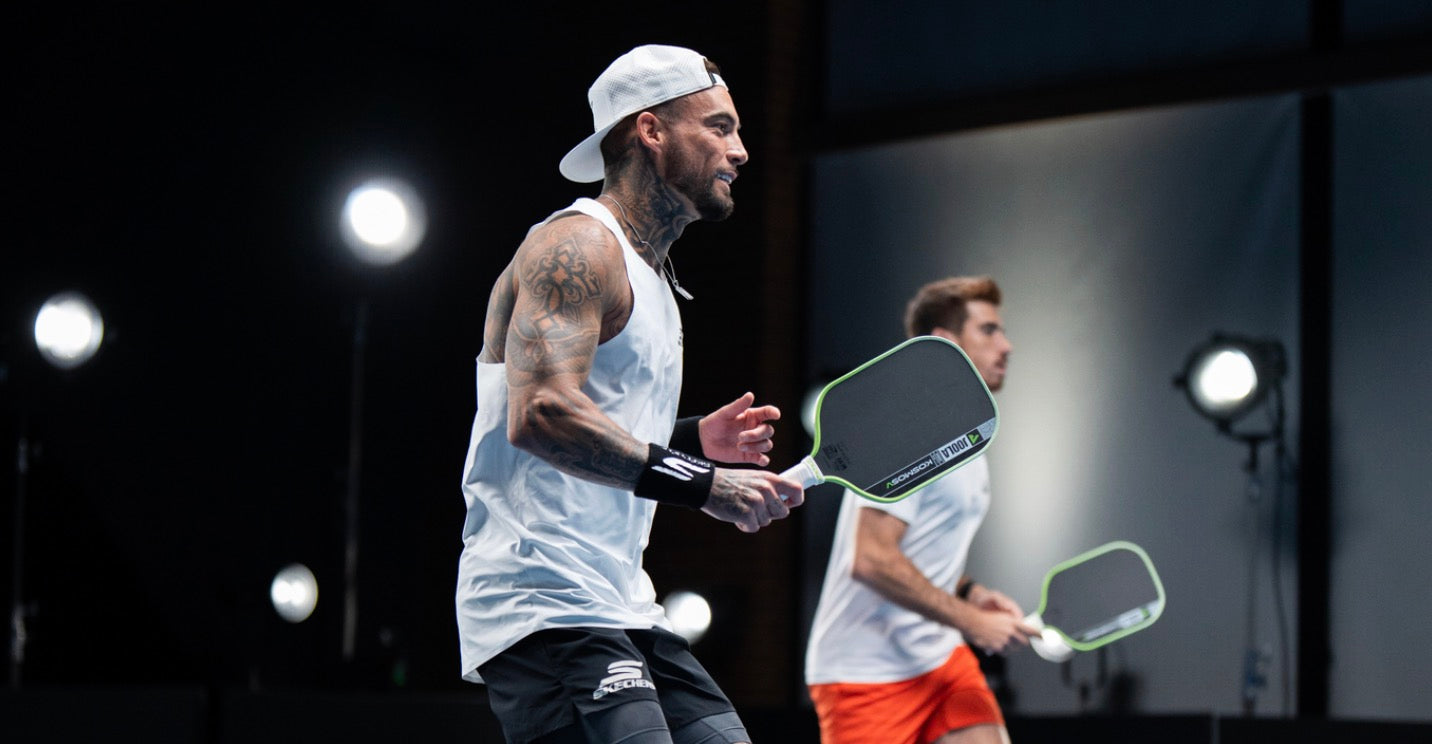
With the launch of the Pro V series, JOOLA has introduced a new hybrid shape to their paddle lineup called the Kosmos.
The Kosmos is a blend between the popular Perseus and Scorpeus shapes and is being used by pros Federico Staksrud (16mm) and Tyson McGuffin (14mm). Notably, JOOLA chose to go with a flat top on its hybrid paddle, compared to most other hybrids from other companies that have a curved top. While the curved top might offer more maneuverability, JOOLA’s engineers said having a flat top meant more stability and forgiveness.
For this review I will be focused on the 16mm version — I’ll dive more into my thoughts below, but in general players can expect the 16mm to offer a bit more dwell time and more of a plush feel, while the 14mm version has slightly more pop in hands battles.
Shop the JOOLA Pro V Kosmos
Order here (paddle officially launches March 3)
All of the Pro V models feature a new “KineticFrame” that is built to flex and recover during impact. Unlike prior paddles with a “diving board” neck flex, the KineticFrame allows the paddle head to move parallel to its original position. This results in a more predictable & repeatable exit trajectory as well as more precise power (the more you put in, the more you get out).

Read next: How JOOLA took inspiration from golf and hockey to create new Pro V series pickleball paddles
At the JOOLA Pro V launch event in Arizona last week, JOOLA Product Manager Austin Kim said their testing indicated a significant decrease in launch angle deviation from prior models. Essentially, the ball rebounds almost perpendicular to the paddle face, which gives players more precision. Kim described it as “the difference between in and out” in real-world situations.
I definitely felt a difference in playing and drilling with the paddle compared to the JOOLA Pro IV and other popular paddles on the market. Kim and others at the JOOLA event warned me that the paddle would take some adjusting to because the KineticFrame is a unique concept that hasn’t been done before in the pickleball industry.
I can attest to that. At first, I was a little bit unsure about the paddle and there were some shots that reacted in a way I didn’t expect. But after a couple hours, I really started to get a feel for the ball and was able to dial in my shots.
In that sense, the Pro V seems geared toward higher level players who can make small adjustments to get the most out of a paddle.
JOOLA Kosmos Pro V — How it plays
When I’m testing a paddle, I work with other high-level players in my area to simulate a wide variety of shots. This testing involves several hours of drills and 5.0+ games in an effort to determine how the paddle impacts performance in real-world scenarios compared to other top-tier paddles on the market.
Drives/serves (8/10) – My focus for this category is whether these shots are putting pressure on my opponent in terms of power and spin. The Kosmos definitely isn’t the hottest paddle on the market, but I was able to shape the ball how I wanted to and could swing confidently knowing the ball wasn’t going to explode off the paddle face in an unpredictable way. The JOOLA engineers that I talked to last week really hammered home the idea of precise power, and I felt that on shots from the baseline.
Dinks/drops (9.5/10) – This is where the Kosmos really shines, in my opinion. If you’ve watched Federico Staksrud play in the last two weeks, he has been using a third-shot hybrid drop/drive (also known as a drip) a lot. After playing with the Kosmos, I can see why that shot has been working well for him lately. The dwell and shot shaping ability is really high on this paddle, so you feel like you can put the ball exactly where you want on dinks and drops.
Resets (9.5/10) – I actually have the Pro IV rated slightly higher in this area than the Pro V, but that might change as I’m able to use the paddle some more. They feel pretty similar on shots in the transition zone, so it could just be a matter of being more familiar with the Pro IV, which is an important factor on shots that require a lot of touch.
Pop (8/10) – This is another area where I felt like the Pro V and Pro IV are pretty similar as far as speed off the paddle face, but the KineticFrame featured in the Pro V makes a big difference when it comes to placement. Because you don’t usually have a lot of time to react in hands battles, the launch angle deviation can be exacerbated when you’re not able to get the paddle into the exact right position. For example, if you’re slightly late on a counter and your paddle face is already more open than you want it to be, any further bending of the paddle like a diving board is going to mean the ball comes off at more of an angle than you want it to. With the way the Pro V flexes, the launch angle is more “true” to where you have your paddle face.
Flicks/speedups (10/10) – It makes sense that JOOLA would make a paddle that performs really well on these type of shots because their marquee pro player — Ben Johns — has arguably the most dangerous backhand flick out of the air. The added dwell time on the Pro V makes it so you can be really precise and hold the ball on the paddle for as long as possible on these type of shots.
Aggressive attacks/overheads (8/10) – The raw power on the Pro V is slightly dialed back from the top power paddles on the market, but I think that’s probably a good thing for most people. Especially if you play with a LifeTime ball (which plays faster than most other balls), the Pro V has plenty of putaway power. When I was playing with it, I never felt like I needed or wanted more power.

Summary
One of the things I was always really impressed by with the Pro IV was the fact that it delivered top-tier power while also performing really well on drops, dinks and resets. Because JOOLA kept the same core design (the propulsion core that is featured in the 3S and Pro IV models), I felt similarly about the Pro V — I still got the power when I wanted it and control when I needed it.
The biggest difference to me seems to be that the Pro V offers slightly more dwell time, which allowed me to be very precise with my shot shaping on drops, drips and flicks out of the air.
I expect JOOLA to get some criticism from the public for coming out with another Gen 3 paddle while many other companies are moving toward full foam paddles, but I actually really like that they stuck with the same core. I’ve always thought good Gen 3 paddles offer a higher performance ceiling than foam, and I appreciate that JOOLA is prioritizing performance and making small tweaks to improve something they already know works, rather than chasing the flavor of the month.
Check out our current “best of” lists
– The best shoes for pickleball players
– The best pickleball paddles for power players
– The best pickleball paddles for control players
– The best pickleball paddles for spin
– The best pickleball paddles under $200
– The best pickleball paddles under $150
– The best pickleball paddles for beginners
– The best women’s signature pickleball paddles, from a female perspective
– The best bags designed specifically for pickleball