

Expert review: Honolulu J6CR is full foam done right
This page contains affiliate links. The Kitchen may earn a commission from purchases at no extra cost to you.
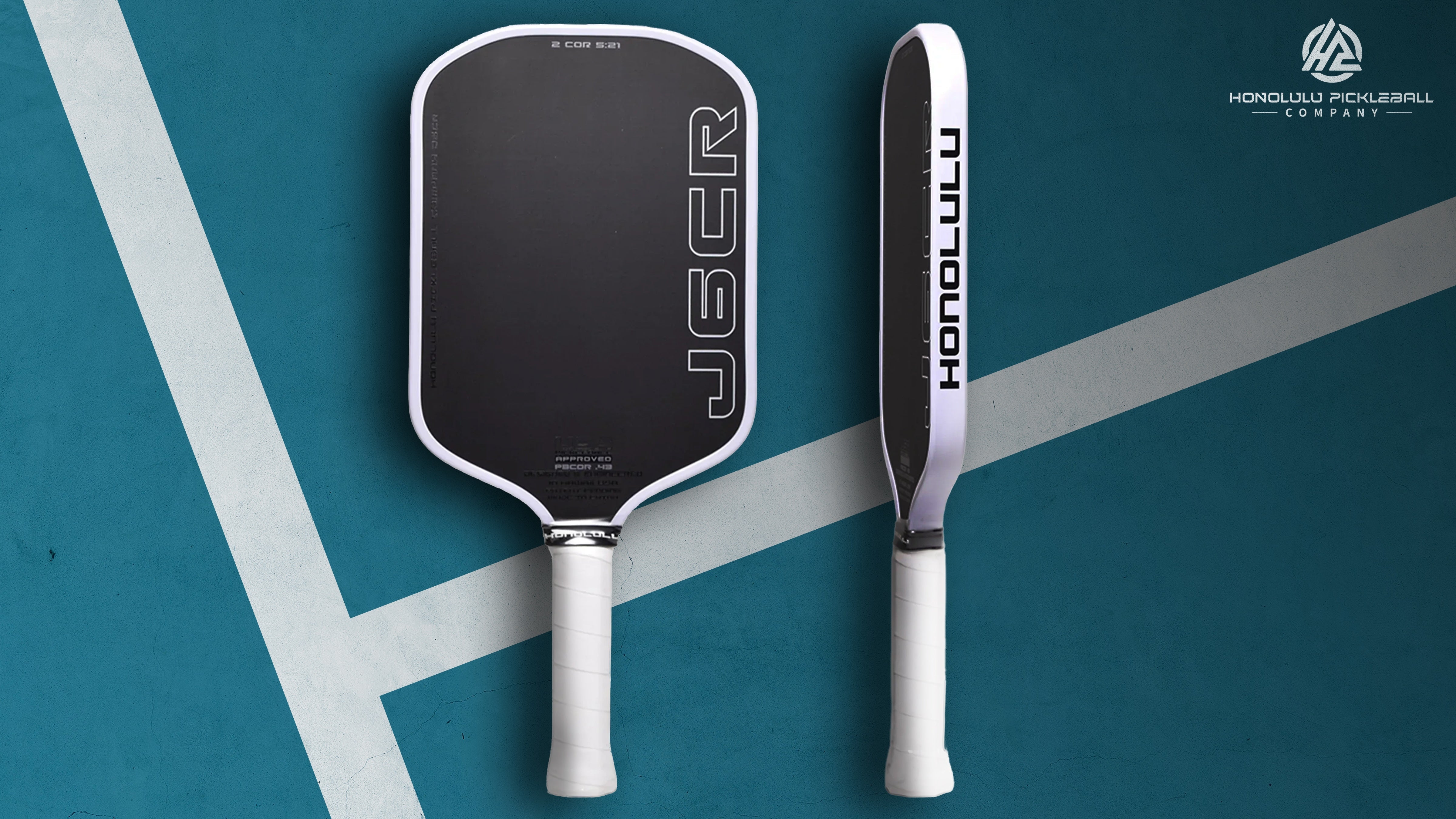
The Honolulu J6CR has been trickling out into the pickleball paddle market for a couple months now. Rather than setting a hard launch date, the company has been taking pre-orders and fulfilling those orders as they receive more stock.
That has resulted in the paddle almost always being sold out — right now the next batch is scheduled to ship on March 31.
It makes sense that it would be in high demand, because out of all the full-foam paddles that I have tried over the past year, the J6CR makes a convincing case as the best.
Use code “KITCHEN” at checkout for 10% off
In this review I will dive into what sets the J6CR apart from other paddles that use a full-foam core and how it performs on the court.
Here’s a look at what’s under the hood:

As you can see, there’s a lot going on with the core of the J6CR.
The notched external foam adds weight and stability toward the bottom third of the paddle face, while the bowl-shaped cutout in the center of the paddle is meant to add flex and create more of a “pocketing” effect on contact. Honolulu calls this their “Dynamic PowerFlex Technology.”
HONOLULU J6CR SPECS
Weight: 8.0 ounces
Swing weight: 112
Twist weight: 6.2
Paddle length: 16.5 inches
Paddle width: 7.5 inches
Handle length: 6 inches
Surface: Carbon fiber
Core: 16mm
Note: Honolulu has teased the release of what they’re calling “Crystal Blue Endurance” surface grit, which is meant to be a longer-lasting and potentially more gritty surface than raw carbon fiber. As of this review, the version of the J6CR with the new grit has not been approved by USA Pickleball and I do not have a J6CR with the Crystal Blue grit. This review is based on the carbon fiber model.
For reasons beyond my expertise, some full-foam paddles seem more sensitive to perimeter weighting than others. The J6CR is one of those. Because this paddle has a very low swing weight out of the box for an elongated model, I initially added some UDrippin tungsten tape to the sides and top corners to bring the swing weight up to around 120, which is what I’m used to.
When I did that, the power exploded with this paddle. So much so that I ended up moving the weight down to the bottom sides and throat area. It was too much for me with my original setup, but if max power is what you’re looking for, know that it can be achieved while keeping the swing weight comfortable.
Honolulu J6CR — How it plays
When I’m testing a paddle, I work with other high-level players in my area to simulate a wide variety of shots. This testing involves several hours of drills and 5.0+ games in an effort to determine how the paddle impacts performance in real-world scenarios compared to other top-tier paddles on the market.
Drives/serves (9/10) – My focus for this category is whether these shots are putting pressure on my opponent in terms of power and spin. Even without the weight at the top, the power is still very good and the paddle delivers much more of a “pocketing” feel than most other full-foam paddles on the market. That meant I was able to add plenty of shape to get my drives to dip aggressively over the net.
Dinks/drops (9.5/10) – This is where the feel of the J6CR really stands out in the full-foam category. It seems to me that the cutout in the core makes a big difference on shots that require more touch. While other foam paddles can feel very stiff and have lower dwell time, the J6CR felt more like a broken in Gen 3 paddle. That added dwell time is very important on dinks and drops because it allows me to hit those shots with aggressive topspin and be very precise with placement.
Resets (8/10) – While I could do a lot with the ball and felt like I had good touch when I was on balance and had time to set up for my shot, absorbing pace from an opponent’s attack was a little more tricky. The paddle performed well in the transition zone after some adjustment, but I was still popping some balls up higher than I wanted to. Honolulu intends to come out with a hybrid and widebody shape in this series — I would expect those models to perform better on resets.
Pop (8/10) – The J6CR lives in a good place when it comes to pop. It has plenty of juice to put you ahead in hands battles if you time up a counter attack, but it’s not so poppy that you’re going to spray balls all over the place. That’s been a criticism I’ve had with other full-foam paddles — I think the pop on the Selkirk Boomstik and Bread & Butter Loco is honestly too much for most people, myself included. So I would rather have an 8/10 than a 10/10 when it comes to this category, especially if I’m using the LifeTime ball, which is already very poppy.
Flicks/speedups (9.5/10) – This is another area where the pocketing effect/added dwell time was very apparent with the J6CR. I could flick balls from below the net and get them to land in, and I could also place attacks out of the air exactly where I wanted (or pretty close). The lower swing weight also helps in this area — you can really whip through the ball and add a ton of shape.
Aggressive attacks/overheads (8.5/10) – With the weight setup that I settled on, I had plenty of putaway power. But this category can kind of be whatever you want depending on how much weight you add. Out of the box it’s probably closer to an 8/10, but if you add weight on the sides/top corners, it can easily be a 10/10 in terms of raw power.

Summary
As of this writing, the Honolulu J6CR is my favorite full-foam paddle. I am somebody who still prefers the feel and overall performance of Gen 3 paddles, but if I had to use a full-foam paddle in a tournament it would definitely be this one right now.
Check out our current “best of” lists
– The best shoes for pickleball players
– The best pickleball paddles for power players
– The best pickleball paddles for control players
– The best pickleball paddles for spin
– The best pickleball paddles under $200
– The best pickleball paddles under $150
– The best pickleball paddles for beginners
– The best women’s signature pickleball paddles, from a female perspective
– The best bags designed specifically for pickleball