

Six Zero Black Opal vs. Six Zero Coral: Which should you choose?
This page contains affiliate links. The Kitchen may earn a commission from purchases at no extra cost to you.
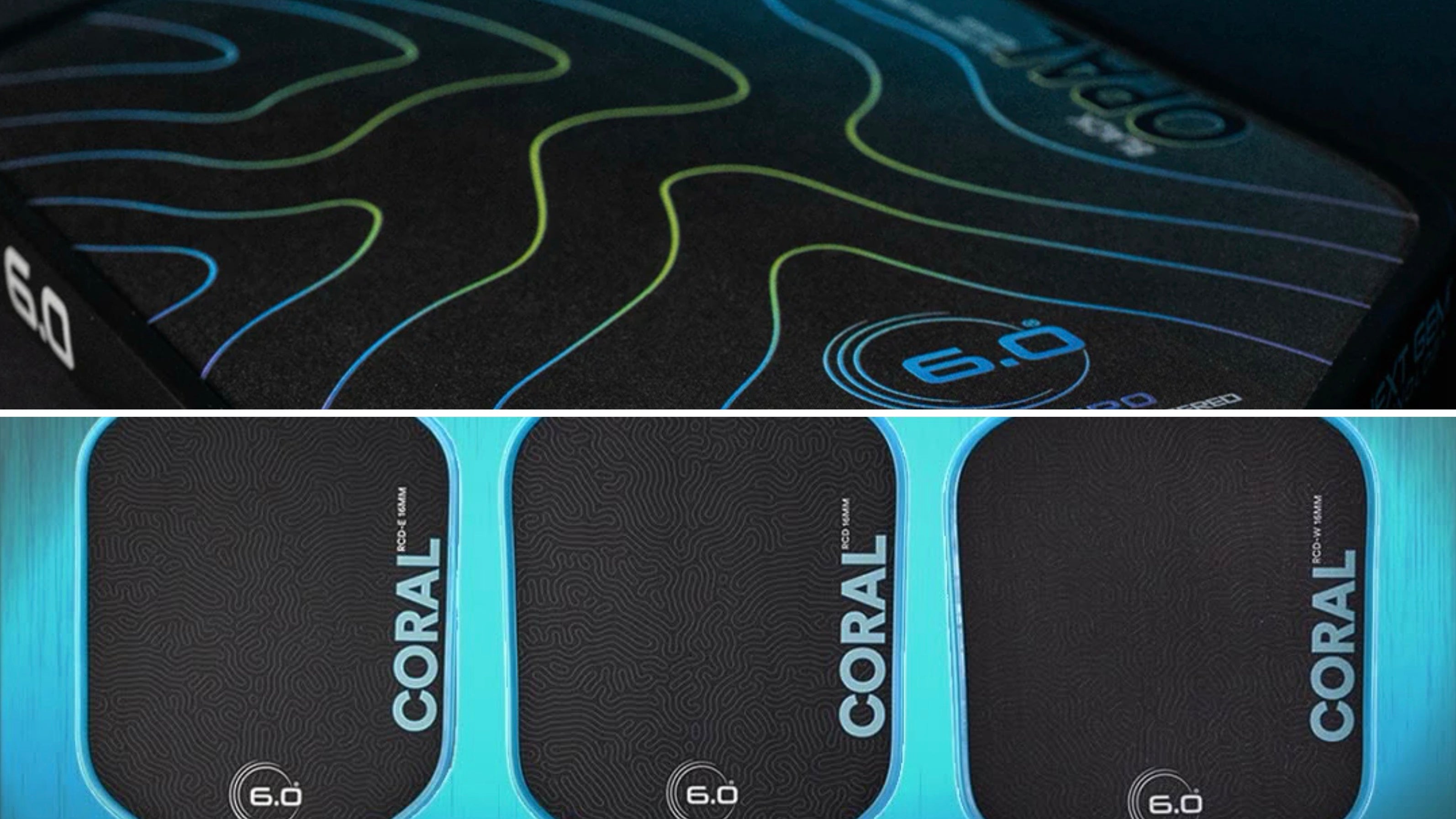
Six Zero released two paddles this fall, and both have already been very popular.
The Black Opal and Coral paddles each use a 100% foam core, but offer different playing characteristics and are geared toward different types of players.
I’ve had these paddles (the hybrid version of both) for about a month and have put them through my usual testing that includes drills from the kitchen line, in the transition zone and from the baseline — as well as several hours of 5.0+ play.
Below I dive more into how each model differs and what type of player might be best suited to each.
The basics
SIX ZERO BLACK OPAL
Price: $250 — use code “KITCHEN” for 10% off
Surface: “Diamond Tough” Raw Carbon Fiber
Core: “G4 Aerospace” Solid Foam Core
Shape: Hybrid
Handle length: 5.5 inches
Static weight: 8.0-8.3 ounces
Swing weight: 113
Twist weight: 6.6

SIX ZERO CORAL
Price: $200 — use code “KITCHEN” for 10% off
Surface: “Diamond Tough” Raw Carbon Fiber
Core: “Tectonic Core” with “ProPulsion” Foam
Shape: Available in widebody, hybrid, elongated
Handle length: 5.5 inches (hybrid, widebody); 5.75 inches (elongaged)
Static weight: 8.0-8.3 ounces
Swing weight: 110 (widebody), 114 (hybrid), 117 (elongated)
Twist weight: 7.1 (widebody), 6.7 (hybrid), 5.9 (elongated)

How they play
Black Opal (buy now, $250 — use code “KITCHEN” for 10% off)
At the kitchen: This paddle delivers top-tier pop in hands battles and great power on putaways. And because of its hybrid shape and 14mm thickness, it’s very maneuverable in fast exchanges and on flicks out of the air. It also has good dwell time, which means those flicks are more controllable — I found that I was able to place the ball where I wanted to very effectively on attacks out of the air and speed-ups off the bounce, which I attributed to the “pocketing” sensation that I was getting on those shots. As with most powerful paddles, dinking can be a bit touchy, but I felt pretty comfortable on the soft shots after a few hours of drilling.
In transition: The biggest knock on this paddle is that the sweet spot isn’t as big as some other “premium” paddles on the market. That issue definitely showed up in this area of the court. When I was the one being attacked, it was sometimes difficult to take enough pace off the ball, and other times the ball would just die if I caught it too low or too high on the face. I did add a 5-inch strip of 1-gram per inch UDrippin tungsten tape at the throat/bottom corners, which helped give the paddle a more stable feel on resets, but it still wasn’t great in this area of the court.
From the baseline: The paddle has a unique feel on drops and drives from the baseline. It felt lively and springy, which meant that I could shape the ball very well on hard and soft shots. If you’re somebody who plays with a lot of topspin on shots from the baseline, this is a great paddle for that. It did require a slight adjustment on drives, which was taking a little bit shorter swing and aiming a little higher than I’m used to and trusting that the spin would bring it down in time.
Coral (buy now, $200 — use code “KITCHEN” for 10% off)
At the kitchen: There’s a noticeable drop off in pop and power in hands battles and on overheads compared to the Black Opal, but that also comes with more consistency on dinks. The other big difference was in maneuverability — even though the swing weights are similar (113 for the Black Opal hybrid, 114 for the Coral hybrid), the Coral felt more clunky in comparison due to the added thickness.
In transition: This is where the Coral has a big advantage over the Black Opal (and many other top paddles on the market). It feels very stable and consistent on resets, the sweet spot is generous, and it doesn’t have the same “jumpiness” that I was feeling with the Black Opal.
From the baseline: The consistency that I felt in the transition zone is just as apparent from the baseline, but I wasn’t able to get the same topspin on drops and drives or the same level of precision in terms of placement. But if you’re a player who mostly relies on hitting more of a soft, floaty drop and then working you’re way into the kitchen line from there, I could see the Coral being a good fit for that.
Which one is best for you?
I think buying a pickleball paddle is starting to become a little bit like buying a car, and these two paddles are a great example of that.
The Coral is like a nice SUV — sturdy, reliable and consistent, but it isn’t going to wow anybody. What it will do is get you from Point A (the baseline in this analogy) to Point B (the kitchen line) very effectively, and it’s well suited to a wider range of players (3.0-4.5).
The Black Opal, on the other hand, is like a sports car — It has a much higher ceiling in terms of power, pop and spin, but those attributes can only be harnessed by more more skilled players (think 4.5+). A 3.0 or 3.5 player buying a Black Opal would be like a novice driver jumping into a Corvette without knowing how to drive a stick shift.
That difference is also reflected in the price. You’re paying more for a Black Opal than a Coral because the Black Opal has more firepower for players who demand peak performance.