

How JOOLA took inspiration from golf and hockey to create new Pro V series pickleball paddles
This page contains affiliate links. The Kitchen may earn a commission from purchases at no extra cost to you.
Paddle flex has been a focus for JOOLA’s pickleball engineers for several years.
When the company released it’s “Gen 3” line — which was followed up by the Mod TA-15 and the 3S series — the patented “propulsion core” functioned like a diving board, bending on impact and springing back into place to transfer more energy to the ball.
The brand followed that up by introducing foam inserts at the throat of the paddle for the Pro IV series, which JOOLA called “Tech Flex Power” and allowed the paddle to flex even more — adding forgiveness while enhancing feel, power and dwell time.
Now JOOLA is innovating even further when it comes to paddle flex, introducing a new “KineticFrame” in its new Pro V models, which was inspired by kick-point engineering in hockey sticks and golf clubs.
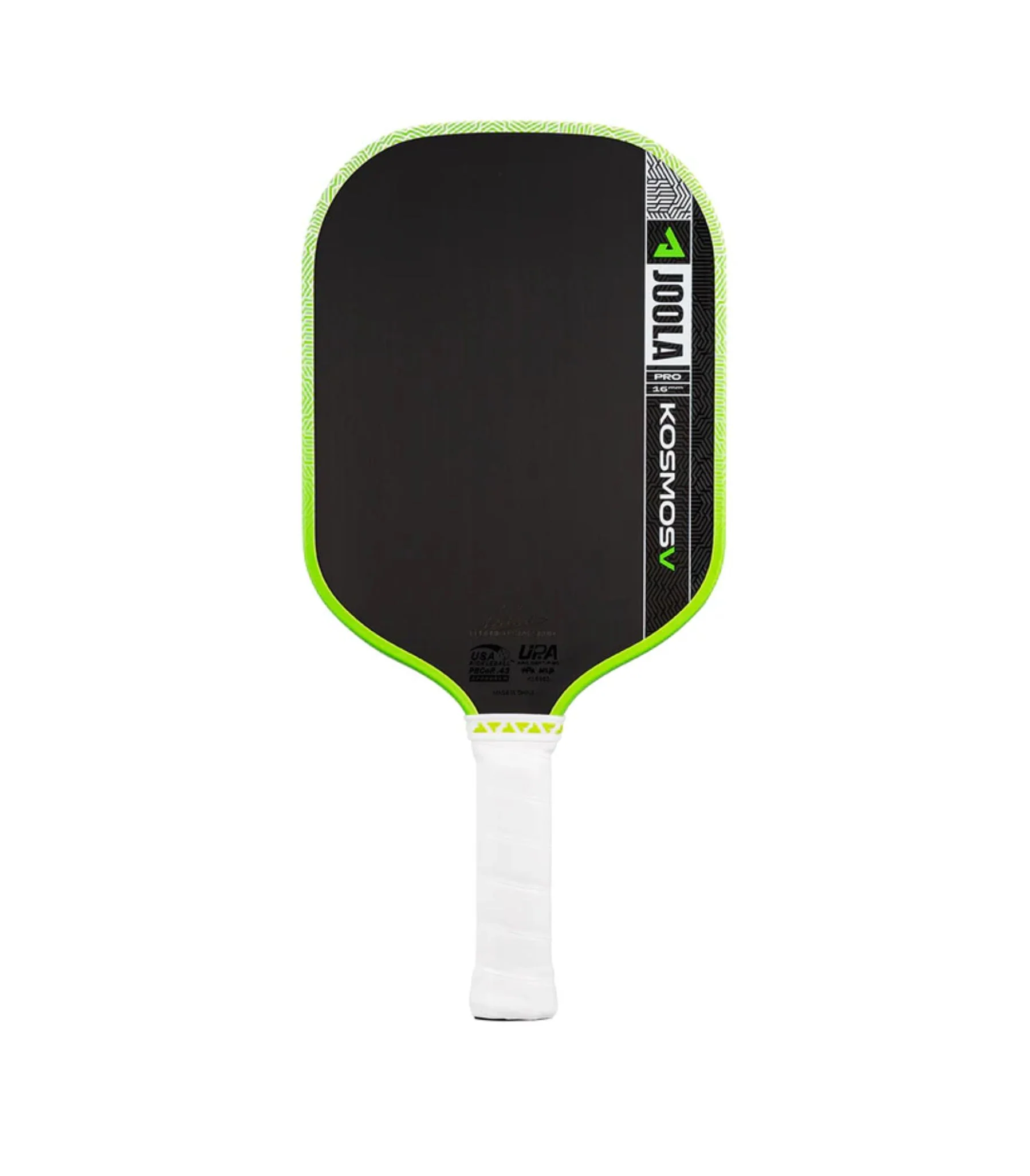
JOOLA Pro V Series
Buy from The Kitchen Shop and get a FREE Kitchen hat with your purchase!
The KineticFrame is built to flex and recover during impact, and unlike prior paddles with a “diving board” neck flex, the KineticFrame uses a proprietary flex-point architecture that allows the paddle head to move parallel to its original position.
The dual-pivot design produces a motion that delivers:
– Predictable & repeatable exit trajectory.
– Uncapped, precise power (ie. the more you put in, the more you get out).
– Reduced launch-angle deviation.
– Faster snapback for rapid exchanges.
– Improved energy transfer efficiency.


In addition to the new KineticFrame, the Pro V series paddles keep the brand’s propulsion core and “Hyperfoam” edge wall, so the overall feel will be familiar for fans of the JOOLA Pro IV, but with added benefits mainly associated with the more predictable exit trajectory, or what JOOLA calls the difference between “in” and “out.”
Why not full foam?
In the past year, many companies have released 100% foam core paddles, whereas almost all paddles had featured a polypropylene honeycomb core previously.
JOOLA is bucking that trend with the Pro V by sticking with polypropylene for the core. In a presentation to industry experts earlier this month, JOOLA Product Manager Austin Kim said they felt like they had a really solid base with the existing propulsion core and weren’t done innovating on that base.
The honeycomb core also provides the feel and performance preferred by top players, Kim said, compared to the stiffer and more “muted” feedback of many full-foam paddles.
In that sense, the kick-point concept wasn’t the only thing that is comparable to golf and hockey. In those industries, top manufacturers typically make small tweaks to existing products each year, which add up to significant improvements over time. Think about drivers in golf, for example — this year’s flagship Titleist driver is not drastically different than last year’s Titleist driver, but rather a minor improvement over last year’s model that is designed for players seeking ultimate performance.
In other words, JOOLA isn’t trying to reinvent the wheel by making drastic changes to the materials they know work well. They’re just trying to make the Pro V a little bit better than the Pro IV (which was already very good).
What about durability?
The downside of using a honeycomb core compared to a foam core is durability. Core-crushing/delaminating and paddles exceeding legal power thresholds over time has been a concern in the industry for years.
To solve for this issue, JOOLA’s engineers added carbon-fiber reinforcements to the top area of the paddle where they had seen a majority of core crushing occur in past JOOLA models and paddles from other brands.
Introducing a new shape
Another criticism JOOLA faced in the past was the lack of a hybrid shape in the 3S and Pro IV lineups. With the Pro V, the brand has introduced the “Kosmos” shape, which is a cross between the popular Perseus and Scorpeus models.
Federico Staksrud (16mm) and Tyson McGuffin (14mm) both have signature Kosmos Pro V paddles and have already put them in play on the PPA Tour.
A vast majority of the brand’s other sponsored players have also switched to their respective Pro V models, including Ben Johns (Perseus shape), Anna Bright (Scorpeus), Kate Fahey (Agassi) and many others.