

3 big myths holding your pickleball game back — Part 1
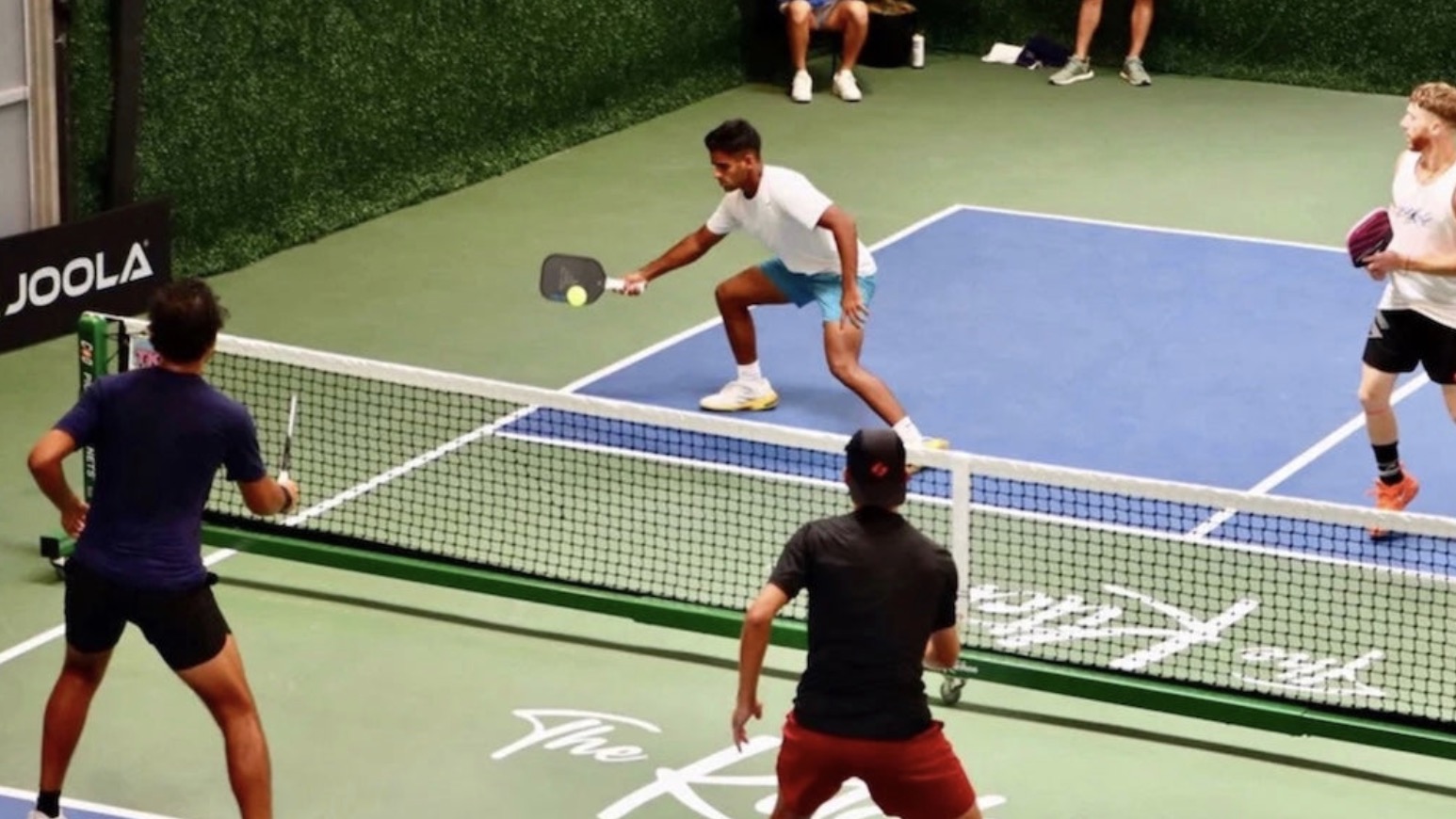
Before I became a pickleball coach, I was a pickleball player. As part of my “training” at the local courts, fellow players imparted their “wisdom” onto me.
Three bits of advice I received shortly after I began playing were particularly disruptive to my play. Let’s avoid further damage to your play by debunking these myths and replacing them with a better approach.
Read next: The best pickleball paddles for intermediate players
Myth No. 1 — moving with your partner
This article debunks the widely held belief that you are supposed to move with your partner. You will hear it said whenever there is a question about whether a player moved as they were supposed to.
“Oh yeah. I’m supposed to move with my partner.”
This is no bueno for your game. Let me show you why:
The easiest way to debunk this myth is to put it into practice. Let’s say you and I are partnered. You’re serving, and I’m standing behind the baseline diligently waiting for the third shot. The return is hit deep and directly at me – so the third shot is mine. I line up behind the baseline (it was a deep return after all) and hit an amazing third-shot drop towards the middle “T” spot.
Our opponent pops the ball up and you … Wait a minute? Why are you still here at the baseline with me? Oh no!!!!! I forgot that you are under the “move with your partner” spell. So, naturally, you were waiting for me to move forward so you could go. Makes sense. Or does it?
Would it not have been better for you to have moved forward ahead of me to put the pop up away? I say yes, and if you and I were partnered, I would want you up there capitalizing on my amazing third-shot drop.
Read next: Ranking our Top 13 paddles on the market right now + in-depth reviews for each one
Let’s move the rally forward to see how “move with your partner” still doesn’t work even after the initial misstep. Since we missed the put-away opportunity generated by my third-shot drop, we now have to hit our fifth shot, presumably from somewhere in the transition zone. The ball is traveling toward you, and so you hit the fifth shot. Being diligent in following “move with your partner,” I track you exactly to the same line you are hitting from (to keep that imaginary tether line between us).
You hit the shot. Now do we move? Who decides? Maybe I should ask you, “Hey, do you want to move up now?” Or do you ask me? Do I look over to you to read your body language and see if you are beginning a forward movement? Or do you look over at me?
You can do this thought experiment for different situations, and it is always equally funny and confusing. When you put “move with your partner” into practice, it just does not work.
So how come when you watch the pros play it looks like they are moving together? Great question. The answer is because they are moving …
Read next: The best pickleball paddles for spin
Truth No. 1 – Move with the ball
When you’re playing pickleball, the universe reduces to a roughly 3-inch sphere. The ball is our North Star out on the court. If the ball is hit to the left, we move left. To the right, we move right. If the ball is lobbed, we go back and get it.
That is what the pros are doing. Each partner is independently moving with respect to the ball. The reason it looks like they move together is that they are each moving correctly relative to the ball. If the dink is hit toward the left side of the court, the left-side player slides left, and the right-side player also slides left. Almost as if there were a tether between them.
But when one pro player drives a third shot off an attackable return, their partner doesn’t hang back and wait to move with their partner. Instead, they move forward and attack any resulting pop up. When an ATP is attempted, the player opposite the ATP slides back and over to the sideline to cover while their partner also slides but usually remains up closer to the kitchen line. These cases are examples of each player moving independently relative to the ball and the conditions on the court.
Read next: Blue Ridge Pickle Barn offers slice of pickleball paradise in North Georgia
How you can use this coaching
- Move your body relative to the ball. The simplest version of this is sliding on the court according to where the ball is left to right. Add a body-squaring idea to your movement to make it even better: Present the front of your body at 90 degrees to the ball.
- Learn to move according to the conditions on the court. This is a long-term process as pickleball is a complex sport, but here are several examples: If you read a good third-shot drop hit by your partner, move forward to apply pressure. If your opponent never comes in on their return of serve, move forward as soon as you are able to. If you’re playing a chronic lobber, sag off the kitchen line as soon as you sense a lob may be coming.
Closing thoughts
To enjoy a more complete pickleball experience, you will want to become a more knowledgeable pickleball player. This means building an understanding of the game’s framework so you can become resistant to the many myths that pervade our sport. Articles like this one will go a long way toward your better understanding. That’s because we don’t just tell you the thing. Rather, we explain the why of it all. You deserve no less.
Be on the lookout for the next myth in this series.